CIVIL SOCIETY
FLOOD: NEMA TASKS BENUE ON READINESS, COORDINATED RESPONSE


FLOOD: NEMA TASKS BENUE ON READINESS, COORDINATED RESPONSE
The National Emergency Management Agency (NEMA) has advised the Benue State Government to sustain its preparedness against flooding and urged residents, particularly those in vulnerable communities, to remain alert as the state continues to experience heavy rainfall.
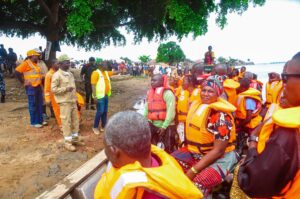
The Director General of NEMA, Mrs Zubaida Umar, gave the advice on Thursday during a full-scale flood response simulation exercise involving relevant stakeholders in Makurdi, Benue State. The exercise was preceded by intensive training of relevant stakeholders and community engagement aimed at strengthening operational preparedness, improving coordination and enhancing public awareness of appropriate actions before and during flood emergencies.
Mrs Zubaida Umar, who was represented by the Director, Search and Rescue, Air Commodore Usman Bature, said Benue State remains vulnerable to flooding due to its topography, extensive river systems and floodplains, seasonal rainfall patterns, as well as settlements along the River Benue and its tributaries.
She said the 2026 flood outlook underscores the need for sustained preparedness, effective early warning, coordinated response and timely evacuation of people from communities at risk.
The Director General explained that the national disaster response framework is designed to operate from the bottom up, with initial action beginning at the community level and escalating through Local Emergency Management Committees (LEMCs) and the Benue State Emergency Management Agency (SEMA) to NEMA for additional federal support where required.
Speaking on the importance of the simulation exercise, the Director General of NEMA said:
“This exercise is not merely a demonstration of equipment or procedures. It is an opportunity to test, under realistic conditions, how quickly and effectively we can move from early warning to community action, local coordination, state-level response and, where necessary, federal support.
“The bottom-up escalation pathway from community response to local government efforts through LEMCs, to the state through SEMA and federal support through NEMA is intended to ensure that assistance begins as close as possible to the affected population while progressively bringing in additional capacity as the situation escalates.”
She assured that NEMA would continue to work with the Benue State Government and other stakeholders to strengthen preparedness, reduce vulnerabilities and enhance capacities to save lives and protect livelihoods.
“The success of this exercise will ultimately be measured not by how impressive the simulation appears, but by how much better prepared we are when confronted with an actual flood emergency,” she said.
The Governor of Benue State, Rev. Fr. Hyacinth Alia, said the state’s location along the River Benue exposes many communities to recurring flooding.
Governor Alia, who was represented by the Deputy Governor, Dr Sam Ode, said the prevailing humanitarian and disaster management challenges require sustained preparedness, effective coordination, continuous training and prompt response.
According to him, the simulation provided an important opportunity to test existing systems, strengthen operational readiness, identify gaps and deepen inter-agency collaboration.
Governor Alia said the water rescue and evacuation component of the exercise was particularly relevant to Benue State, expressing optimism that lessons from the simulation would strengthen preparedness and facilitate faster and more coordinated responses during actual emergencies.
He also reaffirmed the commitment of the Benue State Government to work with NEMA towards the implementation of the Rehabilitation Scheme for Persons Impacted by Conflicts (RSPIC) in the state to support displaced and conflict-affected persons.
17th September, 2026