CIVIL SOCIETY
ROADS ARE FREEDOM” — SAYS UMAHI AS STUDENTS PROJECTS INSPECTION VALIDATE TINUBU’S INFRASTRUCTURE REVOLUTION

ROADS ARE FREEDOM” — SAYS UMAHI AS STUDENTS PROJECTS INSPECTION VALIDATE TINUBU’S INFRASTRUCTURE REVOLUTION
The nationwide inspection of Federal Government road projects by the leadership of the National Association of Nigerian Students (NANS) has given a fresh dimension to the conversation around the infrastructure programme of President Bola Ahmed Tinubu’s administration, with the Minister of Works, Senator Engr. David Umahi, CON, describing roads as “freedom” for Nigerians.
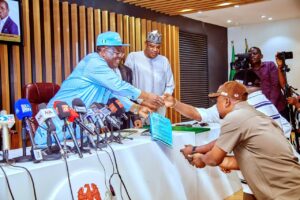
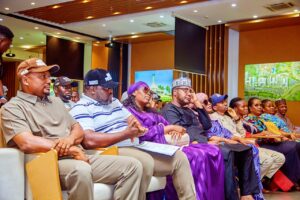
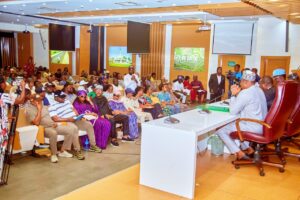
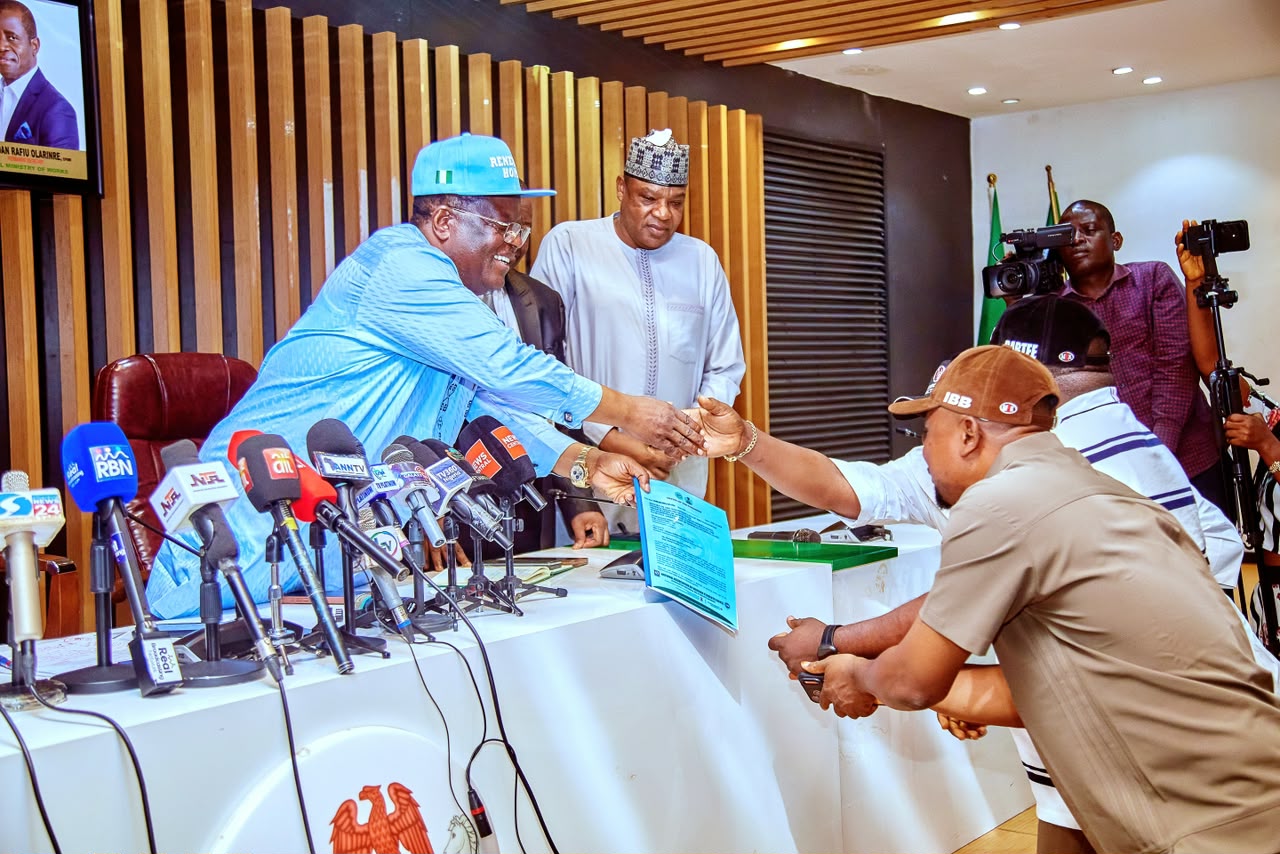
Receiving the report of the students’ inspection tour in Abuja on Tuesday, September 22, 2026, Umahi commended the student leaders for choosing to physically inspect the projects rather than relying solely on political narratives, government reports or what they hear from others.
The NANS delegation, led by its President, Comrade Babatunde Akinteye Afeez, had embarked on a nationwide Federal Roads Project Tour, inspecting projects in parts of the North West and other areas of the country. The exercise was designed to enable the students to assess the quality, progress and impact of Federal Government road projects on students, tertiary institutions, businesses and surrounding communities.
Following their inspection, the students commended the quality, durability and pace of construction on the projects visited, while identifying areas requiring additional attention, particularly pedestrian bridges around tertiary institutions where major highways intersect with campus access routes.
Speaking during the engagement, Umahi said what particularly impressed him was that the student leadership independently requested access to project sites across the six geopolitical zones.
According to him, even when the Ministry offered to assist with logistics, the students declined, insisting that they wanted to see the projects themselves and form their own assessment.
“They want to see these projects we talked about. I think this is effective leadership, and I pray that this is responsible leadership,” the Minister said.
Umahi said the students’ decision to travel across the country and inspect infrastructure firsthand demonstrated a responsible approach to leadership, adding that they were determined to establish for themselves the extent to which the infrastructure programme was impacting Nigerians.
“They were tired of hearing the success story of the infrastructure revolution in Nigeria, and they ventured on their own to go and see for themselves how it positively impacts on the lives and safety of their students,” he said.
He commended the NANS President and his colleagues for taking the initiative, describing the students as important stakeholders in the future of Nigeria.
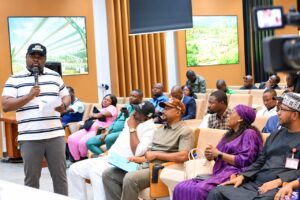
Presenting their findings, the NANS President, Comrade Babatunde Akinteye, said the students deliberately embarked on the inspection to establish the condition of the roads themselves and understand how the projects are affecting education, mobility, safety and economic activities.
The student leadership commended the Federal Government for the quality and pace of work observed on the projects, particularly the use of durable pavement technology, improved drainage systems, road expansion and the integration of safety infrastructure such as solar-powered street lighting.
Responding to the students, Umahi explained that roads and bridges are not simply concrete structures or transportation facilities, but the backbone of economic activity and a major determinant of how freely people can move, trade, work, study and access opportunities.
“Let me tell you, it is the road and bridges sector, the works sector, that grows the GDP of every nation. And it is the backbone of all other GDP,” he said.
“When people cannot move from one point to another, it is tantamount to imprisonment. And a man that is imprisoned has no freedom. But while we are doing this beautiful infrastructure revolution in Nigeria, it is freedom we are giving to our people.”
Umahi said this was the thinking behind the Federal Government’s focus on major highways and strategic road corridors across the country.
He also linked the road programme to national security, explaining that improved roads, street lighting and CCTV surveillance would reduce isolation along highways and improve the ability of security agencies and citizens to monitor and use the routes safely.
The Minister urged stakeholders and supporters of the administration to communicate with Nigerians through facts, projects and records, saying the scale of infrastructure development provides sufficient material for public engagement.
“We have bragging rights under President Bola Tinubu to campaign with. But our mouth will not be shut. We have to let people know what is happening now that never happened before,” he said.
Umahi said the responsibility was to ensure that Nigerians knew what was happening across the country rather than allowing infrastructure projects to remain poorly communicated.
“I’m proud of what the President is doing in infrastructure. I’m proud of other gains we have made in various sectors of the economy. So we have to tell our stories. If you don’t say it, nobody may tell you.”
He urged stakeholders, including student leaders and community engagement officials, to continue taking citizens to project sites so they could see the work for themselves.
The Minister also described President Tinubu’s infrastructure programme as deliberate, particularly in its emphasis on durability.
He highlighted the use of reinforced concrete pavement on selected major roads, saying the technology was intended to provide longer-lasting infrastructure and reduce the burden created by Nigeria’s maintenance challenges.
“The President is very intentional because when the roads and bridges are done, then the country is on autopilot,” Umahi said.
He noted that the administration was pursuing infrastructure projects that had been discussed for many years without reaching completion, citing the Lagos-Calabar Coastal Highway and the Sokoto-Badagry corridor among major national infrastructure ambitions.
“Only President Bola Tinubu is giving that opportunity to dream and then to perform,” he said.
Umahi also clarified what he described as misconceptions surrounding the Federal Government’s legacy road projects, explaining that many of the projects are not entirely new roads but the reconstruction, expansion and modernisation of existing routes.
He cited the Akwanga-Jos Road, explaining that it is an existing road being reconstructed and expanded. He also mentioned the Gombe-Biu corridor and disclosed that the Ministry is designing the Gombe-Bauchi and Bauchi-Jos corridors as part of a broader connectivity strategy.
The Minister said the projects should be viewed as long-term infrastructure investments, particularly given the financing arrangements involving foreign funding and tolling mechanisms upon completion.
On the Lagos-Calabar Coastal Highway, Umahi strongly defended the strategic importance of the project, arguing that it should not be viewed simply as a Lagos project because much of its route runs through the Niger Delta.
He noted the importance of infrastructure investment across the coastal states and linked the project to economic development, regional connectivity and the long-term development of the Niger Delta.
The minister also connected infrastructure development with efforts to address longstanding socio-economic challenges in the region, including the Ogoni area, stressing that improved infrastructure would support communities, businesses and future investment while strengthening connectivity across the region.
Reacting to a statement by Ayede, Umahi said he had no intention of leaving office and challenged critics to examine the infrastructure projects being executed across the country.
“I take note that Chief Ayede says that I should resign. I’m not about to resign. But if Ayede knows the projects that President Bola Tinubu has done in South-South, I think he will eat his words,” he said.
He maintained that the scale of ongoing construction demonstrates the administration’s response to Nigeria’s infrastructure needs.
“Take me anywhere in this country, any region that is not a construction site. And so we have a lot to campaign for the President. We have a lot.”
The Minister also defended the Tinubu administration’s decision to remove fuel subsidy, arguing that the discussion should include the fiscal consequences of the previous subsidy regime, Federation Account revenues and government debt obligations.
He warned against promises to restore fuel subsidy without explaining how such a policy would be financed and urged political actors to engage Nigerians on concrete policies and explain what they intend to do differently.
“So we should engage constructively to debate about the future of the country,” he said.
Umahi further connected road construction with national security, noting that poor and isolated roads have historically created difficult environments for movement and provided opportunities for criminal activities.
He said the integration of solar lighting, CCTV surveillance and improved road networks would make major highways safer, citing the Abuja-Kaduna-Zaria-Kano corridor as an example of the Federal Government’s investment in solar-powered street lighting and planned surveillance infrastructure.
According to the Minister, the infrastructure programme is therefore not only about transportation but also about commerce, education, security, investment and economic growth.
The Minister directed relevant officials to take note of the requests of the students and assured the students that the Ministry would address identified safety concerns.
“To the students, the pedestrian bridge you requested, I want the directors to take note of it. We’ll do it,” he said.
He cited the University of Abuja and Nnamdi Azikiwe University, Awka, among institutions where pedestrian bridge requests were being considered.
“As long as you make your request for the safety of our students, we will definitely look into it,” Umahi assured.
He said future road designs would, where possible, incorporate safer access arrangements around tertiary institutions.
Umahi also urged the students and other stakeholders to continue communicating their firsthand experiences of Federal Government projects, saying citizens should be encouraged to visit project sites and see the infrastructure for themselves.
He encouraged the Senior Special Assistant to the President on Community Engagement to mobilise citizens in their respective states and zones to understand the projects being executed in their communities.
At the end of the engagement, Umahi announced additional support for the SSAs, saying he regarded them as partners in engaging Nigerians and communicating development.
Umahi announced that friends and partners had put together busses to support them in nationwide engagement and pledged continued cooperation.
He thanked the NANS leadership for what he described as a responsible approach to national development.
The Special Advisers to the President on Community Engagement also commended President Bola Ahmed Tinubu and the Minister of Works for the road infrastructure projects being executed across their respective zones.
Francis Nwaze, FIPMD
Senior Special Assistant to the Honourable Minister of Works (Media)
September 22, 2026