CIVIL SOCIETY
West and Central Africans support women’s autonomy and sexuality education, but are divided on contraceptive access

Accra, Ghana
24 September 2026
News release
West and Central Africans support women’s autonomy and sexuality education, but are divided on contraceptive access
West and Central Africans express support for women’s right to make choices about marriage and childbearing, a new Afrobarometer analysis reports.
Large majorities also endorse sexuality education in schools and continued education for pregnant girls and young mothers,
But views are divided on whether contraceptives should be made available regardless of marital status and age.
Afrobarometer explored Africans’ views on sexual and reproductive health and rights in its Round 10 surveys in 38 countries. The new report focuses on 18 countries in West and Central Africa.
Key findings
On average across 18 West and Central African countries, more than seven in 10 respondents (72%) say that girls and women should be able to decide for themselves whether and when to get married (Figure 1).
o A slimmer majority (53%) believe that women should be able to decide how many children to have and when to have them.
Three-quarters (76%) of West and Central Africans – including majorities in all 18 surveyed countries – endorse the teaching of sexuality education in school (Figure 2).
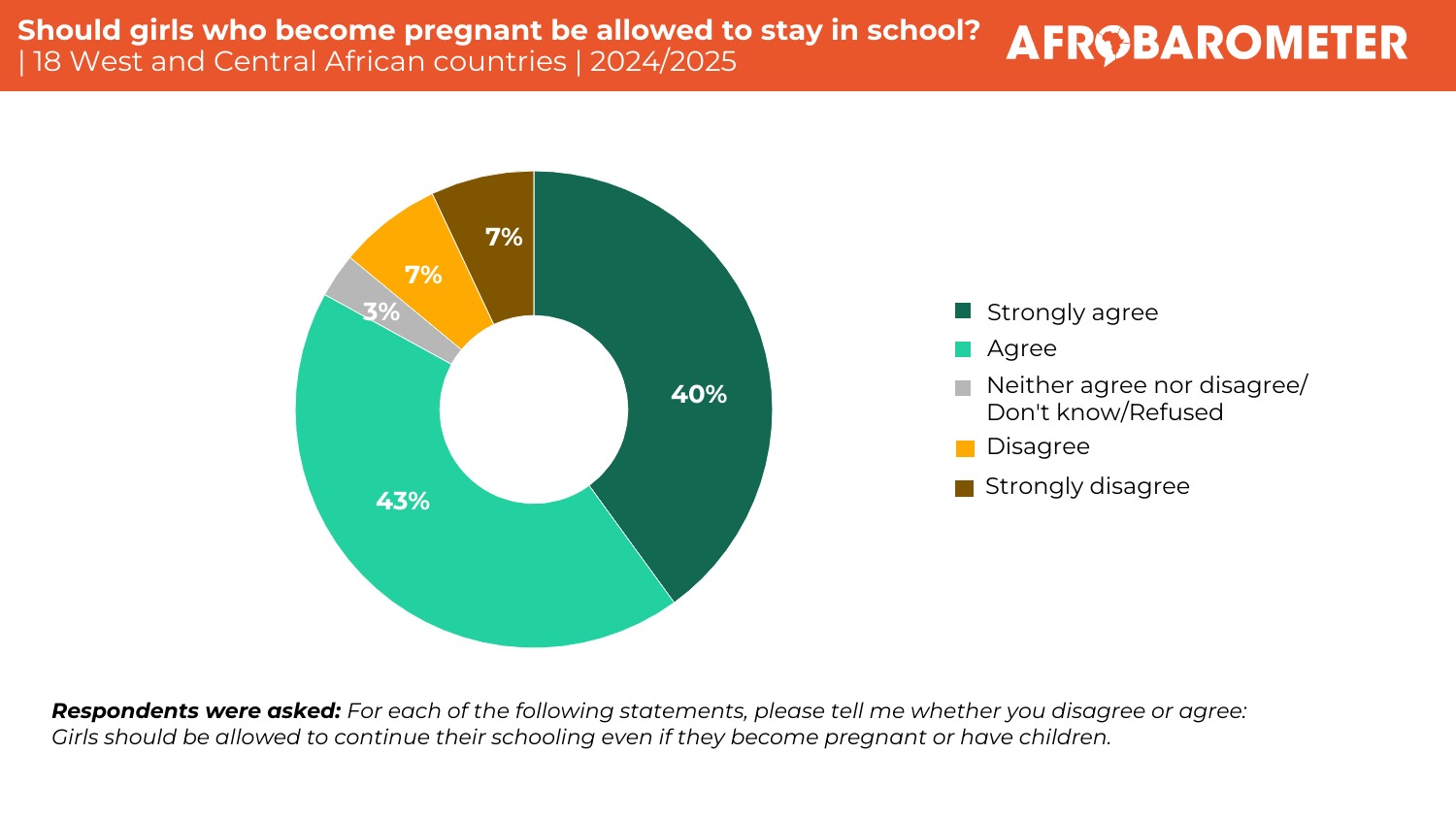
An even larger majority (83%) – including at least seven in 10 respondents in all surveyed countries – say girls who get pregnant or have children should be allowed to continue their schooling (Figure 3).
But views are divided on who should have access to contraceptives. A slim majority (54%) say contraceptives should be made available to anyone who is sexually active regardless of marital status, while half (50%) endorse access to contraceptives regardless of age (Figure 4).
o Opinions on contraceptive access vary dramatically by country, from overwhelming support in Cabo Verde to overwhelming opposition in The Gambia (Figure 5).
o Access to contraceptives regardless of marital status and age wins greater support among women, more educated and wealthier citizens, urban residents, and youth than among their various counterparts (Figure 6).
Afrobarometer surveys
Afrobarometer is a pan-African, nonpartisan survey research network that provides reliable data on African experiences and evaluations of democracy, governance, and quality of life. Ten survey rounds in up to 45 countries have been completed since 1999. Round 10 surveys (2024/2025) cover 38 countries.
Afrobarometer’s National Partners conduct face-to-face interviews in the language of the respondent’s choice. Nationally representative samples of 1,200-2,400 adults yield country-level results with margins of error of +/-2 to +/-3 percentage points at a 95% confidence level. For more on the sampling methodology, click here.
This 18-country analysis is based on 21,600 interviews. The data are weighted to ensure nationally representative samples. When reporting multi-country averages, all countries are weighted equally (rather than in proportion to population size).
Charts
Figure 1: Women’s autonomy in decisions about marriage and childbearing | 18 countries | 2024/2025
Respondents were asked: For each of the following statements, please tell me whether you disagree or agree:
Girls and women should decide for themselves whether and when they should marry.
Women should decide for themselves when and how many children they want to have.
Figure 2: Should schools teach sexuality education? | 18 countries | 2024/2025
Respondents were asked: For each of the following statements, please tell me whether you disagree or agree: Schools should teach sexuality education to young people to help them make informed decisions.
Figure 3: Should girls who become pregnant be allowed to stay in school?
| 18 countries | 2024/2025
Respondents were asked: For each of the following statements, please tell me whether you disagree or agree: Girls should be allowed to continue their schooling even if they become pregnant or have children.
Figure 4: Should contraceptives be available regardless of marital status and age?
| 18 countries | 2024/2025
Respondents were asked: For each of the following statements, please tell me whether you disagree or agree:
Contraceptives should be available to everyone who is sexually active regardless of age.
Contraceptives should be available to everyone, regardless of marital status.
Figure 5: Support for making contraceptives available regardless of marital status and age | 18 countries | 2024/2025
Respondents were asked: For each of the following statements, please tell me whether you disagree or agree:
Contraceptives should be available to everyone who is sexually active regardless of age.
Contraceptives should be available to everyone, regardless of marital status.
(% who “agree” or “strongly agree”)
Figure 6: Support for making contraceptives available regardless of marital status and age | by demographic group | 18 countries | 2024/2025
Respondents were asked: For each of the following statements, please tell me whether you disagree or agree:
Contraceptives should be available to everyone who is sexually active regardless of age.
Contraceptives should be available to everyone, regardless of marital status.
(% who “agree” or “strongly agree”)
For more information, please contact:
Mavis Amedegbe
Communications coordinator for anglophone West and North Africa
Email: mamedegbe@afrobarometer.org
Telephone: +233249795959
Visit us online at www.afrobarometer.org.
Follow our releases on #VoicesAfrica.