PRESS RELEASES
IOM Calls for Greater Investment in Durable Solutions as Nigeria’s Humanitarian Response Faces a Significant Funding Shortfall

IOM Calls for Greater Investment in Durable Solutions as Nigeria’s Humanitarian Response Faces a Significant Funding Shortfall
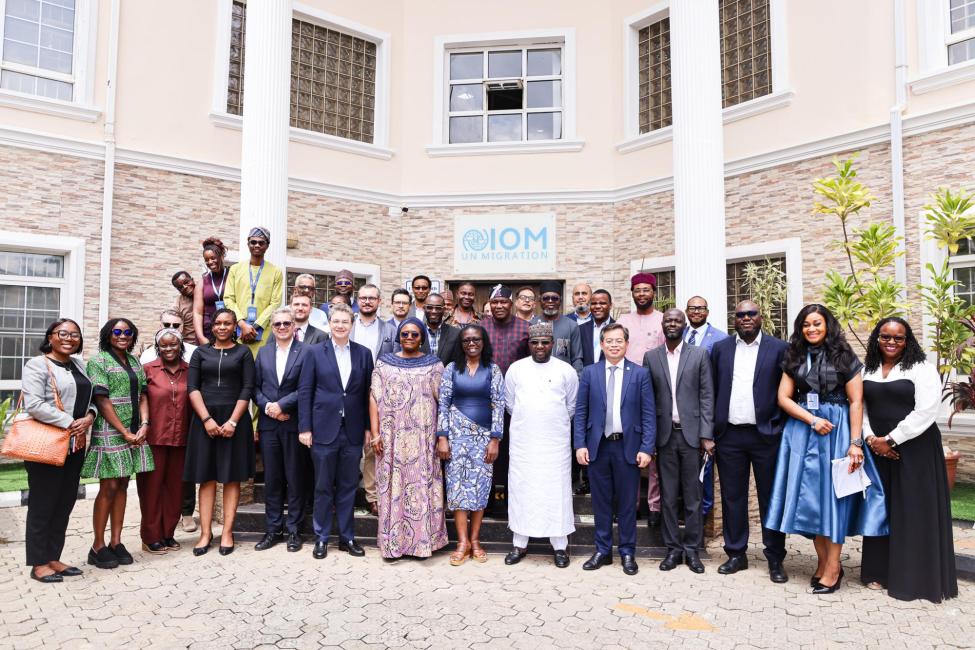
IOM, donors and partners pose for a group photograph following a strategic breakfast meeting focused on strengthening collaboration and advancing humanitarian and development priorities in Nigeria. Photos: IOM2026/ISELOWO Oluwafemi Samuel
Abuja, 02 July 2026 – Nigeria’s 2026 Humanitarian Needs and Response Plan (HNRP) requires $516.4M to reach 2.25 million people in need. Yet with a funding gap of $274.3M, millions of vulnerable people remain at risk of falling further behind unless investments in recovery and resilience are accelerated.
The consequences of this funding shortfall are being felt across Nigeria’s displacement-affected states. Benue State stands at the epicenter of Nigeria’s displacement crisis, with over 460,000 Internally Displace Persons (IDPs) who have lost their homes, livelihoods, and sense of security. In addition, Adamawa is home to over 219,000 IDPs and nearly 932,500 returnees, highlighting both the scale of the challenge and the opportunities for recovery when humanitarian action is matched with long-term investment. Similar needs exist in states across northeast, northwest and north-central Nigeria, where displaced people, returnees and host communities continue to require support to rebuild livelihoods, restore essential services and strengthen resilience.
Against this backdrop, the International Organization for Migration (IOM) today convened senior government officials and key donor partners in Abuja to discuss priority investments needed to strengthen durable solutions across displacement-affected states. The meeting followed a joint donor field visit to Adamawa and Benue States in May this year, where participants met displaced families, returnees and host communities, witnessing first-hand both the impact of ongoing interventions and the significant needs that remain.
Drawing on lessons from the field visit, discussions focused on two priority investment areas. The first is scaling durable solutions through integrated shelter, water and sanitation, climate-resilient community infrastructure and digital systems that improve planning, service delivery and accountability. The second is expanding economic opportunities through livelihoods, skills development, financial inclusion and market access to enable displaced people, returnees and host communities to rebuild sustainable futures and reduce dependence on humanitarian assistance.
As Nigeria’s food basket and one of the states most affected by displacement, Benue has become a strategic priority for durable solutions, resilience building and economic recovery. Despite strong government commitment, including the implementation of a Durable Solutions Action Plan (2025 – 2030) and the Peace Strategy (2026 – 2030), land allocation for reintegration and recovery initiatives, and strengthened coordination mechanisms, significant investment gaps remain. Priority locations such as Guma, Gwer West and Makurdi and other locations require scaled-up support for shelter and community infrastructure, WASH services, livelihoods and agricultural value chains, social cohesion, protection, and local governance systems. Investments are also needed to expand economic opportunities for women and youth, strengthen primary healthcare services, and generate the data and evidence required to guide sustainable recovery and development interventions.
Adamawa, identified as one of the six Tier One states under the World Bank-supported SOLID Project, continues to experience rapid urban growth driven by displacement. Demand for housing, safe water, sanitation, waste management and other essential services continues to outpace available resources, while climate-related risks, including flooding and environmental degradation, are placing additional pressure on vulnerable communities. At the same time, limited access to land, finance and markets continues to constrain economic recovery, particularly for women and young people.
“Communities have shown remarkable resilience, but resilience alone cannot rebuild lives,” said Sharon Dimanche, Chief of Mission for IOM Nigeria. “Families need safe homes, reliable basic services and opportunities to earn a living if recovery is to be sustained.”
She added: “The solutions are well understood. What is needed now is greater, flexible and multi-year investment that bridges humanitarian action with recovery and long-term development. Every dollar invested in durable solutions today reduces future humanitarian needs, strengthens resilience and helps communities contribute to Nigeria’s long-term development.”
IOM called on donors and government partners to increase flexible, multi-year financing for integrated shelter, water and sanitation, climate-resilient infrastructure, digital planning systems and livelihood programmes, while strengthening government-led implementation of durable solutions under the Adamawa State Action Plan and other recovery frameworks. The Organization also encouraged greater investment in scalable initiatives that can be replicated across displacement-affected states.
As displacement becomes increasingly protracted, investing in durable solutions is no longer simply a humanitarian necessity. It is an investment in resilience, stability and sustainable development.
—ENDS—
For more information, please contact Elijah Elaigwu at IOM Nigeria, Tel: +234 707 459 1670, Email: elaigwu@iom.int